
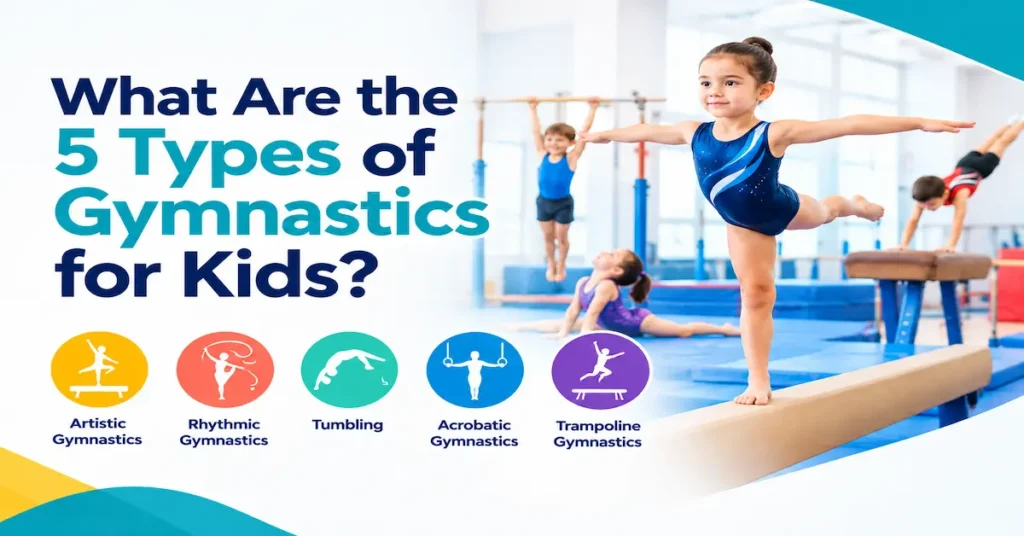
There are five recognised types of gymnastics. They are Artistic, Rhythmic, Trampoline and Tumbling, Acrobatic, and Aerobic gymnastics. Each one trains a different mix of strength, flexibility, rhythm, and teamwork. The right one depends on a child’s personality, not just their ability.
This guide breaks down what each discipline involves. It covers the skills behind each one. It also shows how to match a child’s temperament to the right starting point.
A Brief History of Gymnastics
Gymnastics traces back roughly 2,000 years to ancient Greece. The word itself comes from “gymnos.” This was the bare-bodied training soldiers used to stay fit for battle. Over the centuries, it evolved into a structured sport with formal rules and apparatus.
Artistic gymnastics made its Olympic debut at the first modern Games in 1896. Rhythmic gymnastics joined the Olympic programme in 1984. Trampoline gymnastics is the newest core discipline, added in 2000. Each style built its own techniques. But all of them still centre on body control, flexibility, and strength.
The 5 Types of Gymnastics in Detail
1. Artistic Gymnastics
Artistic gymnastics is the discipline most people picture when they hear the word “gymnastics.” It’s also the one most clubs build their programmes around first.
Women compete across four apparatus:
- Vault: A sprint, then a powerful launch off a vaulting table.
- Uneven bars: Swinging and release skills between two bars at different heights.
- Balance beam: A beam roughly 10cm wide. It demands total concentration.
- Floor exercise: A tumbling and dance routine, set to music.
Men compete across six events: floor, pommel horse, rings, vault, parallel bars, and high bar.
Training and Skills:
Training focuses on tumbling, swinging, balance, and explosive strength. Skills build over years through structured levels. Kids usually start with basic rolls and shapes. Handstands, cartwheels, and apparatus-specific moves come later.
Most clubs offer compulsory levels for beginners. They also offer optional levels for competitive gymnasts. Some run separate pathways for late starters, or for gymnasts with a particular talent on one apparatus.
Benefits of Artistic Gymnastics:
- Full-body strength: Apparatus work demands genuine core and upper-body power.
- Flexibility: Routines on the beam and floor require a wide range of motion.
- Coordination: Years of multi-apparatus training builds exceptional body control.
A randomised controlled trial followed 300 preschool children. A structured gymnastics programme produced significant gross motor skill improvements after 36 weeks. This beat standard extracurricular activity alone. Researchers credited gymnastics’ whole-body movements for the improved coordination.
Competitive Aspect:
Gymnasts are scored on difficulty, execution, and composition. Artistic gymnastics is one of the most demanding disciplines to compete in. It takes years of training to reach higher levels.
For families starting here, recreational and competitive gymnastics programmes rotate children through floor, beam, bars, and vault in one session. This builds skills every other discipline draws on later.
2. Rhythmic Gymnastics
Rhythmic gymnastics blends ballet, dance, and apparatus handling into routines set to music. It’s currently a women’s discipline at the international competition level. Boys do train it recreationally at many clubs.
Routines use five handheld apparatus: rope, hoop, ball, clubs, and ribbon.
Training and Skills:
Training emphasises flexibility, balance, and ballet technique. Gymnasts spend real time on body movement and grace first. Apparatus handling comes after. Managing flexibility, timing, and apparatus control all at once takes years to master.
Benefits of Rhythmic Gymnastics:
- Artistic expression: Dance elements let children express themselves through movement.
- Flexibility: Ballet-based training builds great range, especially through the back and shoulders.
- Rhythm and timing: Routines must match music precisely. This sharpens musicality.
Competitive Aspect:
Routines are judged on artistry, apparatus control, and fluid movement. Competitions run individually and in groups. Rhythmic gymnastics has been an Olympic sport since 1984.
Rhythmic training needs little space or equipment. That makes it easy to practise at home alongside club sessions.
3. Trampoline and Tumbling Gymnastics
Trampoline and Tumbling is often shortened to T&T. It’s the newest Olympic discipline. It’s also one of the fastest-growing in youth participation. It covers four competitive events:
- Individual trampoline: A set routine of ten skills, judged on height, form, and difficulty.
- Synchronised trampoline: Two athletes perform identical routines on adjacent trampolines.
- Double mini trampoline: A short run-up onto a smaller trampoline. It ends in a dismount.
- Power tumbling: Flips and twists, performed along a sprung tumbling track.
Training and Skills:
Training focuses on aerial awareness, timing, and control. Gymnasts practise somersaults, tucks, pikes, and twists. This builds core strength and quick body control.
Elite trampolinists can reach heights of around 8 to 10 metres in competition. That takes real spatial awareness in the air.
Benefits of Trampoline and Tumbling:
- Balance and spatial awareness: Repeated bouncing sharpens body control in the air.
- Core strength: The sport works the core constantly. This improves posture.
- Confidence: Mastering height and rotation builds real self-belief.
Competitive Aspect:
Competitions combine required skills with a freestyle routine. Judges score precision and difficulty. Tumbling is the floor-based half of the discipline. It develops similar flips and twists, but on a sprung running track instead of a trampoline bed. Many clubs run it as a standalone class for kids who enjoy flips but aren’t ready for full apparatus work.
4. Acrobatic Gymnastics
Acrobatic gymnastics, almost always called “Acro,” is the only major discipline built entirely around partnership rather than solo performance. Athletes compete in pairs, trios, or groups of four. No handheld apparatus is involved. A partner’s body is the equipment.
Training and Skills:
Training focuses on strength and trust between partners. Every pairing has defined roles. A base provides strength and stability. A flyer performs balances and aerial elements. Skills include lifts, throws, catches, and synchronised tumbling.
Benefits of Acrobatic Gymnastics:
- Teamwork: Acro builds real cooperation and trust between partners.
- Strength and power: Bases develop explosive arm, shoulder, and core strength.
- Flexibility and balance: Flyers need great balance to hold tough positions mid-air.
Competitive Aspect:
Teams are judged on technical execution, synchronisation, and artistic expression. Acro is smaller globally than artistic or rhythmic gymnastics. But it has a strong social pull. Kids who struggle training alone often thrive here. Progress depends as much on trust as on individual skill.
5. Aerobic Gymnastics
Aerobic gymnastics is sometimes marketed as Sport Aerobics. It blends gymnastics with high-intensity, music-driven choreography. Routines run individually, or in pairs, trios, and larger groups.
Training and Skills:
Training combines strength work, flexibility, and aerobic endurance. Routines mix strength holds, dynamic jumps, and flexibility elements. A routine usually lasts under two minutes. It runs at near-constant intensity throughout.
Benefits of Aerobic Gymnastics:
- Cardiovascular fitness: The sustained intensity builds real endurance.
- Coordination: Fast-paced choreography demands sharp timing and body control.
- Performance confidence: The dance-like format suits kids who love an audience.
Competitive Aspect:
Judges score difficulty, execution, and artistry, much like artistic gymnastics. But there’s no apparatus, and no balance-beam-style precision event. This discipline suits kids who enjoy performing. It also suits kids who find artistic training too slow.
What Equipment and Safety Matter Most?
Every discipline depends on the right equipment, not just talent. Spring-loaded floors, chalked bars, sturdy vaulting tables, and rated landing mats all cut injury risk. A reputable club should never skimp on any of these.
Gymnastics does carry a genuine injury risk worth understanding. A national US emergency department study found that injury rates were similar between boys and girls aged 7 to 11. The rate nearly doubled for boys aged 12 to 17. Elbow and finger injuries showed up most often in younger girls.
This doesn’t mean avoiding the sport. It means checking a few basics first:
- Qualified coaches: Look for staff trained in age-appropriate progressions.
- Proper matting: Crash mats and landing zones should match the skill level taught.
- Sensible pacing: Skills should build gradually. Strength should catch up first.
How to Choose the Right Discipline for Your Child
Matching personality to discipline matters more than matching ability. Most five- and six-year-olds haven’t found a clear strength yet anyway.
Does your child crave height and speed? Or do they prefer the ground?
Kids who love jumping off furniture usually drift toward trampoline gymnastics. Cautious children often prefer the floor-based control of artistic or rhythmic work.
Do they want to perform solo, or as part of a team?
Artistic, rhythmic, and trampoline gymnastics are mostly individual sports. Acrobatic gymnastics is built on partnership. It often suits socially driven kids better.
Are they drawn to dance and music? Or do they love pure strength?
A child with a dance background usually leans toward rhythmic or aerobic gymnastics. A child who loves climbing frames usually fits artistic gymnastics better.
How much equipment and space is realistically available?
Rhythmic gymnastics needs the least specialised equipment. Artistic and trampoline disciplines need real club facilities from day one.
Most clubs run short trial sessions across two or three disciplines first. This is the fastest way to find the right fit. AAS runs its own gymnastics programme around the Gymnastics Australia Levels framework. Children progress through artistic skills at their own pace. Families can also explore the holiday camps, which mix gymnastics with outdoor and multi-sport options.
At What Age Should Kids Start Gymnastics?
Most clubs accept children from around 18 months for parent-and-child sessions. Structured solo classes typically start between ages 3 and 5. There’s no single “right” age beyond that. Kids who start later can still progress fast. Coordination and confidence matter more early on than raw flexibility.
Conclusion
The five types of gymnastics each build a different set of skills. Artistic gymnastics demands apparatus precision. Acro demands partnership-based trust. There’s no single “best” discipline. The right one matches a child’s natural energy. That might mean a love of height and flips, or music and performance, or working closely with a teammate. A short trial across two or three styles is usually enough to find out.
Frequently Asked Questions
What is the most popular type of gymnastics for kids?
Artistic gymnastics is the most widely practised type. It’s also the most common starting point at clubs. It builds the broadest base of strength, flexibility, and coordination. Other disciplines draw on this base later.
Is rhythmic gymnastics only for girls?
At the elite international level, yes, it’s currently a women’s-only discipline. At a recreational level, many clubs welcome boys into rhythmic classes too.
What age can kids start trampoline gymnastics?
Most clubs introduce basic trampoline skills around age 5 or 6. By then, most kids can manage a soft, controlled bounce. Flips and twists come later, under supervision.
Is acrobatic gymnastics safe for young children?
Yes, when taught by qualified coaches. Good coaches match partner pairings by size, strength, and skill level. Younger children start with simple balances and trust exercises. Lifts and throws come much later.
How many days a week should a child train for gymnastics?
Recreational gymnasts usually train once or twice a week. Competitive-track gymnasts often move to three or more sessions weekly as they progress through levels.
Can a child do more than one type of gymnastics at once?
Yes, and many clubs encourage it, particularly for younger children. Cross-training between disciplines, like adding trampoline sessions to an artistic gymnastics schedule, often builds body awareness faster than specialising early.
What is the difference between gymnastics and tumbling classes?
Tumbling focuses purely on floor-based skills like rolls, handsprings, and flips along a sprung track. Gymnastics more broadly also includes apparatus work, like bars, beam, and vault.
Do kids need to be flexible before starting gymnastics?
No. Flexibility develops through consistent training. It’s rarely a prerequisite. Most beginner classes spend real time on stretching, simply because new gymnasts start without it.
Which type of gymnastics builds the most strength?
Artistic gymnastics generally demands the most raw strength. Apparatus like rings, bars, and parallel bars require gymnasts to support and control their full body weight throughout a routine.
Is gymnastics a good foundation for other sports?
Yes. The balance, coordination, and body awareness built through gymnastics transfer well into sports like dance, diving, basketball, and martial arts. That’s why many coaches recommend it as an early foundation sport before specialising elsewhere.